

Related articles: Products & Markets, UGC introduction, Rewards program introduction, Accessibility
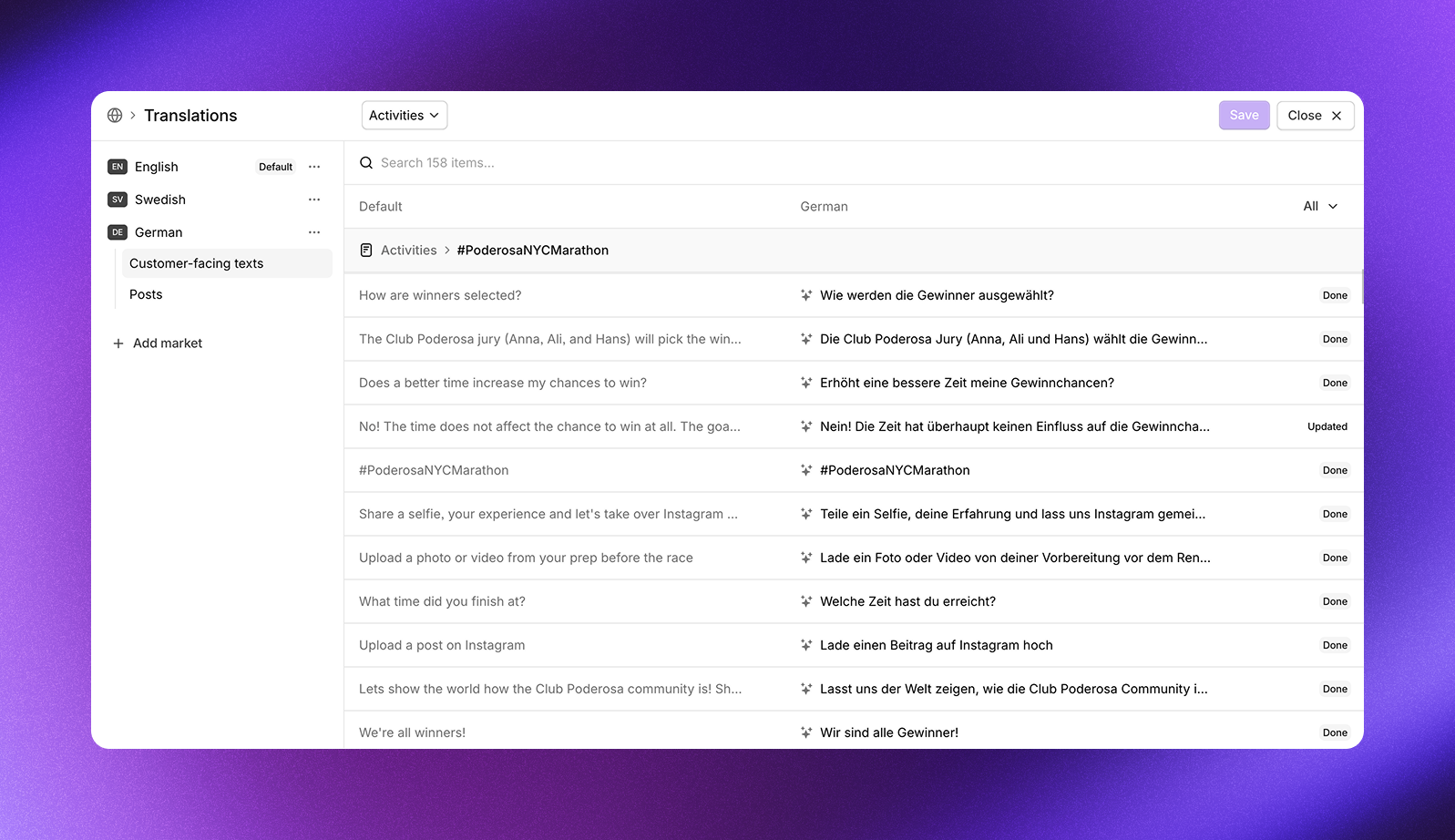
Automatic translations
Cevoid’s AI handles all translations automatically: Widget copy - All text in your UGC and rewards program widgets is translated when you create or edit it. This includes activity descriptions, reward names, button labels, and any custom copy you write. Post content - Captions and accessibility text (alt text, video captions, video descriptions) are translated automatically for each market. Hashtags and @mentions in captions are kept in their original form. You can still make manual adjustments to any translation if needed.Set a custom tone
Give Cevoid’s AI language-specific guidelines to ensure translations match your brand voice for each market.- Navigate to Settings -> Translations
- Click Localize on a language
- Click the menu icon next to the language name
- Click Language settings
- Enter your custom tone guidelines
- Click Save
Primary language
Your workspace’s primary language is the source for all translations. To change your primary language:- Navigate to Settings -> General
- Select the new language under Primary language
- Click Save changes
Where do I write consumer-facing copy?
Copy is written in different places depending on what you’re editing: Program content - Activities, rewards, tiers, and other program content is written where you create it. Navigate to the activity, reward, or tier and edit the copy there. Navigation and general copy - Button labels, headings, and other general copy is pre-written but can be adjusted. Edit your default language in Settings -> Translations, and changes are automatically translated across all languages. UGC copy - UGC widget copy is shared across multiple interfaces, so it’s edited in the same place as navigation and general copy.Navigate the translations page
Click Localize on any language to open the translation editor. The sidebar shows:- Customer-facing texts - Widget copy and other consumer-facing content
- Posts - Caption and accessibility translations for your posts
- Search bar to find specific text
- Dropdown filter by solution (Program, UGC, Activities, Tiers, etc.)
- Filter for texts that need review
Manual adjustments
While translations happen automatically, you can adjust any translation manually.- Navigate to Settings -> Translations
- Click Localize on the language you want to edit
- Find the text you want to change
- Enter your translation
- Click Save
Translation exceptions
Some branded content works better when kept consistent across all languages. Use translation exceptions to control whether tier names and points names are translated or kept in your primary language. Navigate to Settings -> Translations to configure exceptions.
For example, if your points are called “Stars” as part of your brand identity, you may want to keep that name across all markets rather than translating it to “Sterne” in German or “Stjärnor” in Swedish.